Author: Brittany Snyder
Meet Your Adopted Calf!
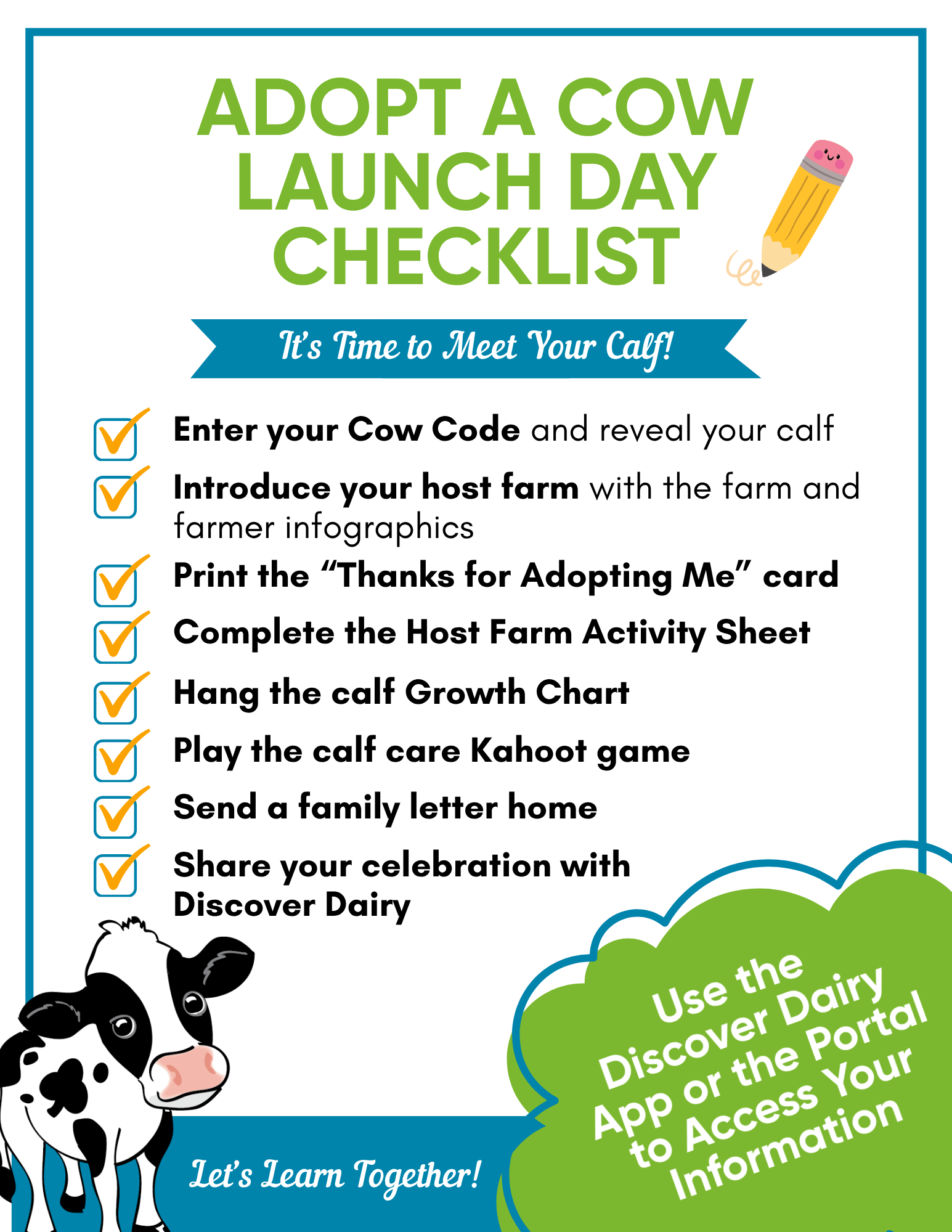
The wait is over! Your host farm and adopted calf are ready to meet you.
Enter your unique Cow Code in the Discover Dairy app or on the Adopt A Cow Calf Updates Portal to unlock your calf’s newborn information, photos, host farm resources, and more. Then, use the activities and classroom resources below to introduce your new calf, explore the farm, and kick off an exciting year of learning.
1. Meet Your Calf and Host Farm
Everything You Need to Make the Big Introduction: Enter your unique Cow Code in the Discover Dairy app or on the Adopt A Cow Portal. Your personalized experience includes information about your adopted calf and the dairy farm caring for her.
Meet Your Calf – Open the Calf Birth tab to find:
- A newborn calf infographic featuring your calf’s first photo and birth information
- Additional photos of your calf
- A printable “Thanks for Adopting Me” card to share with your students
Meet Your Host Farm – Open the Host Farm tab to find:
- A Meet the Farm infographic
- A Meet the Farmer infographic
- The Farm Visitor Policy – PLEASE REVIEW
- Farm contact information and directions for connecting with the farm and calf
- The Host Farm Activity Sheet
2. Introduce Your Host Farm
Put Your Farm on the Map: Use the Host Farm Activity Sheet to help students learn where their adopted calf lives.
Activity Directions:
- Find their host farm’s state worksheet on the app or in the download.
- Locate the farm’s general area on a map.
- Draw or place a pin near the farm’s location.
- Compare the farm’s location with your school or community.
- Discuss similarities and differences between the two areas.
3. Send a Message to Your Host Farm
Send Mail to Your Farmer: Use the Contact Your Farmer tool to send questions, classroom updates, student letters, photos, and messages to your host farm throughout the year..
Examples of things you may share:
- Welcome letters to your calf
- Questions about life on the dairy farm
- Photos of classroom displays
- Thank you cards
- Student artwork
Important to Know
Our host farmers volunteer their time to participate in the Adopt A Cow program. While we encourage you to send messages, farmers spend their days caring for animals, growing crops, and managing their farms.
Every message is appreciated and enjoyed, but farmers may not always have time to respond.
4. Track Your Calf’s Growth
How Tall Will Your Calf Grow? Download, print, and hang the Adopt A Cow Growth Chart in your classroom. Follow the lesson directions carefully to display the chart at the correct height.
Before recording your calf’s first measurement, invite your group to:
- Predict how tall they think the calf was at birth.
- Measure their own heights and compare them with their predictions.
- Predict how tall the calf will be at the end of the school year.
- Record the calf’s height as new updates arrive.
- Compare the calf’s growth with their own height or classroom objects.
- Create a graph showing how the calf changes throughout the year.
5. Send the Excitement Home
Invite Families to Follow the Fun: Let families know that your class, library, cafeteria, or organization has adopted a calf through Discover Dairy. Choose the letter that best fits your group, personalize it, and send it home with participants.
Family Letter Options:
- Download the English Classroom Family Letter
- Download the Spanish Classroom Family Letter
- Download the Cafeteria Family Letter
- Download the Blank Editable Letter
Encourage students to tell their families:
- Their calf’s name and breed
- Where their host farm is located
- Something interesting they learned about the calf
- How their family can follow the calf’s journey throughout the year
6. Launch the Program With a Game
Test Your Calf Knowledge: Kick off your Adopt A Cow experience with a fun class challenge. Use this Kahoot game to introduce students to calf care and animal health while building excitement for the program year.
Suggested introduction:
“Before we meet our calf, let’s see how much we already know about calves and how dairy farmers care for them!”
You could play the game once on launch day and again later in the year to see how much students have learned.
7. Find Ideas for Your Classroom
Make the Program Your Own: There are so many ways to bring your adopted calf into your classroom, library, cafeteria, afterschool program, or learning space.
Explore examples and ideas from other educators, including:
- Calf-themed classroom displays
- Growth chart activities
- Writing and journaling activities
- Reveal parties
Ideas From Other Teachers
- “I revealed the gender to my students by coloring the milk pink that I purchased and allowing them to try it.” – Christy Womack, Third Grade
- “We had a cow magnet we used to move along the measurements of the growth chart to show how tall our cow was getting.” – Christie Nix, Middle School
- “Students researched dairy farms and created their own dairy farm. Students used area and perimeter to make ‘blueprints’ of their farms.” – Heather Dymond, Third Grade
- “Our scholars created Thinking Maps with the information we learned about Alex. We also worked on Canva to create a research project.” – Karell Garcia
8. Share the Moos
Help Your School and Community Join the Fun: Your adopted calf is something worth celebrating! Use the Share the Moos media kit to introduce the program through your school newsletter, website, social media channels, morning announcements, or local media.
The kit can help you share:
- Your calf announcement
- Program updates
- Classroom activities
- Photos of your displays and projects
- The story of how students are connecting with dairy farming
9. Share Your Journey With Us
We Want to See What You Create: How did your students meet their calf? Did you create a bulletin board, hold a calf reveal, complete the Host Farm Activity Sheet, or start tracking your calf’s growth?
Share your classroom photos, activities, displays, and ideas with the Discover Dairy team:
- Email photos and stories to info@discoverdairy.com
- Share your experience on the Discover Dairy Inspiration Station Facebook page
- Use the Share the Moos resources to celebrate with your community
Your ideas may inspire another teacher participating in Adopt A Cow!
10. Across-the Curriculum Connections
Adopt A Cow Works For All Subjects: It is so easy to tie your adopted calf experience into any subject.
Check out this list of activity ideas for each subject:
- Math
- Graph the calf’s height and weight.
- Calculate how much the calf has grown between updates.
- Compare student measurements with calf measurements.
- Use scale to map the distance between the school and host farm.
- Create dairy farm blueprints using area and perimeter.
- Science
- Identify what a newborn calf needs to grow.
- Explore animal health, nutrition, housing, and behavior.
- Compare the life cycle of a dairy cow with another animal.
- Study inherited traits, including coat color and markings.
- Discuss how farmers use observation and data to care for animals.
- English Language Arts
- Write letters or questions to the farmer.
- Create a calf diary from the calf’s point of view.
- Write a news article announcing the adoption.
- Develop a biography of the farmer or farm family.
- Use new dairy vocabulary in stories and informational writing.
- Social Studies and Geography
- Locate the host farm on a state and national map.
- Research the host farm’s region.
- Compare rural, suburban, and urban communities.
- Explore how milk travels from a dairy farm to the community.
- Research agriculture and common crops in the host farm’s state.
- Art and Media
- Draw calf portraits from the provided photos.
- Design a classroom Adopt A Cow logo.
- Create a bulletin board or hallway display.
- Produce a video announcement or mock newscast.
- Create trading cards about the calf, farmer, dairy breeds, and farm careers.
Breed Spotlight: Fleckvieh
What is a Fleckvieh?
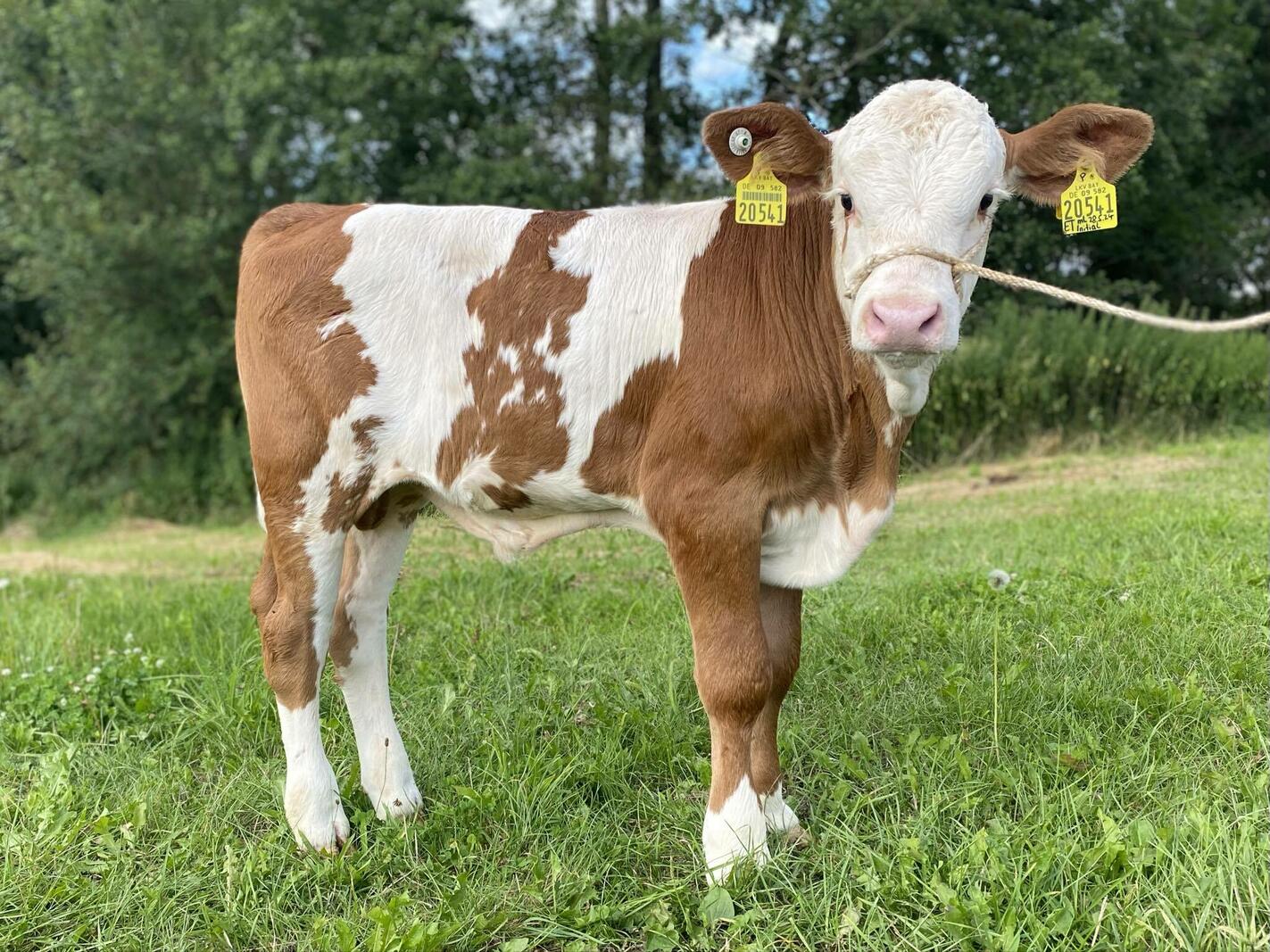
Fleckvieh (pronounced FLECK-vee) is a cattle breed that originated in Austria and Germany. The name means “spotted cattle” in German because of its red and white markings. Fleckvieh cattle were developed from Simmental cattle and are known as a dual-purpose breed, meaning they produce both milk and beef. Fleckvieh cattle are valued for fertility, longevity, calving ease, and adaptability.
Fast Facts
| Trait | Fleckvieh |
| Origin | Austria & Germany |
| Primary Use | Milk & Beef |
| Color | Red and White Spotted |
| Temperament | Calm and easy to work with |
| Special Feature | Produces milk while also raising valuable beef calves |
| Nickname | The Dual-Purpose Dairy Cow |
Why Do Dairy Farmers Use Fleckvieh Genetics?
Many dairy farmers breed Holstein or Jersey cows to Fleckvieh bulls because they are looking for:
- Stronger Calves: They generally have more muscle and growth potential tan traditional dairy calves.
- Healthy, Long-Lived Cows: Their genetics are associated with fertility, longevity, and overall fitness traits.
- The Best of Both Worlds: Farmers can still produce milk while raising calves with a stronger beef value.
- Efficient Animals: The breed is known for converting feed into milk and growth efficiently.
Did You Know?
Fleckvieh is one of the most common cattle types in parts of Europe. In Austria, Fleckvieh cattle make up a large share of the nation’s cattle population because farmers value their flexibility and productivity.
Learn More About Fleckvieh Cattle
- Watch the Austrian Fleckvieh Overview: They call them Simmentals in the video. Fleckviehs are a version of Simmental that have been crossbred to be a duel purpose animal.
- Watch Fleckvieh Cattle Origin TikTok: Listen to a short beef farmer interview while he explains what a Fleckvieh is.
Breed Reveal Is Here! Explore the Wonderful World of Dairy Cow Breeds

One of the most exciting milestones of the Adopt A Cow program is almost here. On October 6, you will officially meet your calf. Before the big reveal, learn more about the breed of your calf. Now is the perfect time to help your students become dairy breed experts!
Just like dogs come in many breeds with unique characteristics, dairy cows do too. Each breed has its own appearance, size, personality traits, and strengths. Dairy farmers carefully select breeds based on factors such as milk production, milk components, feed efficiency, climate, farm goals, and genetics.
To help your students dive deeper into the world of dairy cattle, we have gathered a collection of videos, activities, lessons, and reference resources. Explore one or all of the resources below to build excitement before meeting your calf.
WANT TO LEARN MORE ABOUT FLECKVIEH CROSSES? CLICK HERE to read the Fleckvieh Breed Spotlight!
Meet the Dairy Breeds Video
Start here! This engaging video introduces students to the major breeds of dairy cattle and highlights what makes each one unique.
🔗 Watch the Dairy Breeds Video
Take Action: Challenge students to identify at least three differences they notice between the breeds while watching.
Dairy Cow Breeds Activity Sheet
After watching the video, reinforce learning with this printable activity sheet featuring dairy cow breeds.
🔗 Download the Dairy Cow Breeds Activity Sheet
Take Action: Have students color each cow to match its breed and write down one interesting fact they learned about each breed.
Dairy Breeds Lesson Plan (Grades K-5)
This Agriculture in the Classroom lesson helps students compare dairy breeds and understand their unique characteristics.
Take Action: Ask students to determine which breed they think would be their favorite and explain why.
Discover Dairy 7 Major Breeds Poster (All Ages)
This Agriculture in the Classroom lesson helps students compare dairy breeds and understand their unique characteristics.
Take Action: Add this poster to your classroom to encourage continued conversation about dairy breeds.
A Recipe for Genetics: Selective Breeding and Bioengineering (Grades 9-12)
Older students can investigate how genetics and selective breeding influence the traits farmers select for in dairy cattle.
Take Action: Discuss how selective breeding can help farmers meet the needs of their farms while caring for animals and producing nutritious dairy products.
The 7 Main Breeds of Dairy Cattle
Learn more about the seven major dairy breeds found on farms across the United States.
🔗 Read About the Seven Main Dairy Breeds
Take Action: Create a class chart comparing breed size, color patterns, and milk production traits.
Meet the Cows Handout
This printable handout provides quick facts and breed characteristics that students can use for research or reference.
🔗 Download the Meet the Cows Handout
Take Action: Have students use the handout to create a “Dairy Breed Trading Card” featuring their favorite breed.
Meet the Cows Interactive Resource
Dive deeper into each dairy breed through this online resource packed with breed information and photos.
Take Action: Assign small groups different breeds and have them present what makes their breed unique.
Adopt A Cow Breed Lesson
This Adopt A Cow lesson explores dairy breeds and helps students begin making connections to their future calf.
🔗 Access the Adopt A Cow Lesson
Take Action: Try the Kahoot game in the lesson with your students to test what they have learned.
Dairy Breed Growth Charts
Different breeds grow at different rates. These Penn State growth charts will become especially important after your calf reveal on October 6.
🔗 Download the Breed Growth Charts
Take Action: Save this resource for later and use it throughout the year to predict your calf’s growth and compare predictions to actual updates.
Types of Dairy Cows
Learn about the different dairy breeds and their unique contributions to the dairy industry.
Take Action: Ask students why they think farmers might choose one breed over another and discuss how farm goals can influence those decisions.
Get Ready for October 6!
As you explore these resources, encourage students to look for similarities and differences between breeds and think about why those differences matter. Every dairy breed brings something special to the farm, and soon you will discover which breed your Adopt A Cow calf belongs to.
Start exploring today and get ready to meet your calf on October 6!
Meet Alex: Arizona Teacher Who’s Helping Students Explore Agriculture Career Opportunities
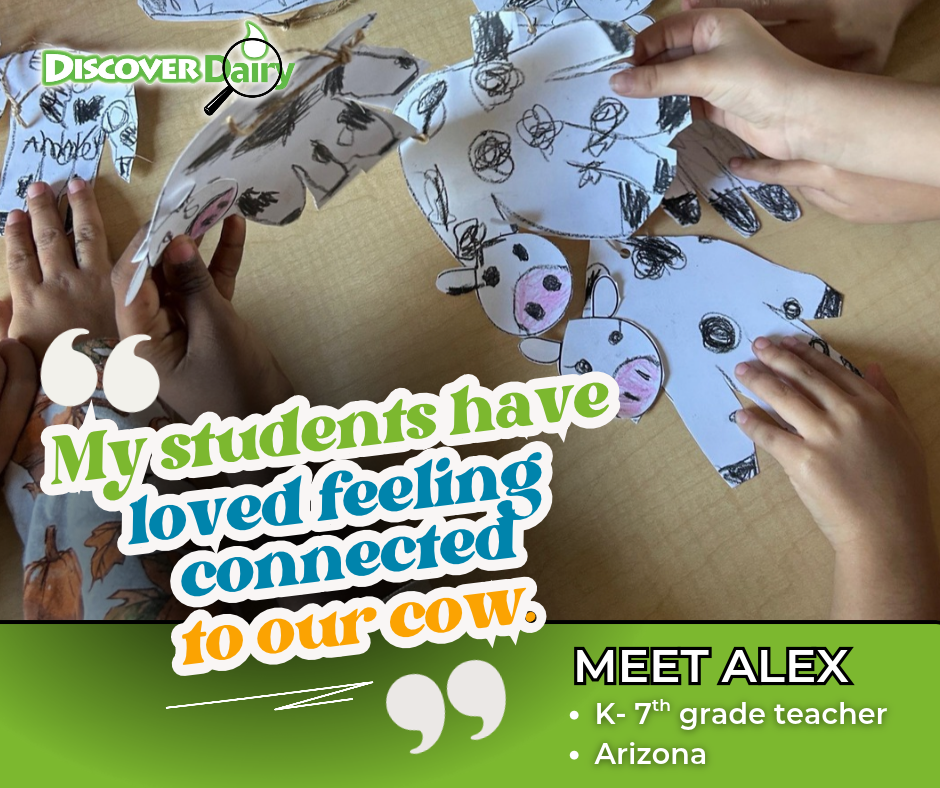
This story is part of a series of “meet & greets” with individuals who use our Adopt a Cow program to inspire you with the endless ways you can incorporate the program in the classroom and beyond!
Alex Layshock teaches elementary and middle school students in a primarily urban area of Arizona. We sat down with her for a quick Q&A about how the Adopt A Cow program is opening her students up to potential career opportunities in agriculture.
How long have you participated in Adopt A Cow? What made you decide to sign up for it?
“This was my first full year participating in Adopt A Cow. I loved the local connection and being able to touch on an important agricultural industry for Arizona.”
What are the demographics of your students?
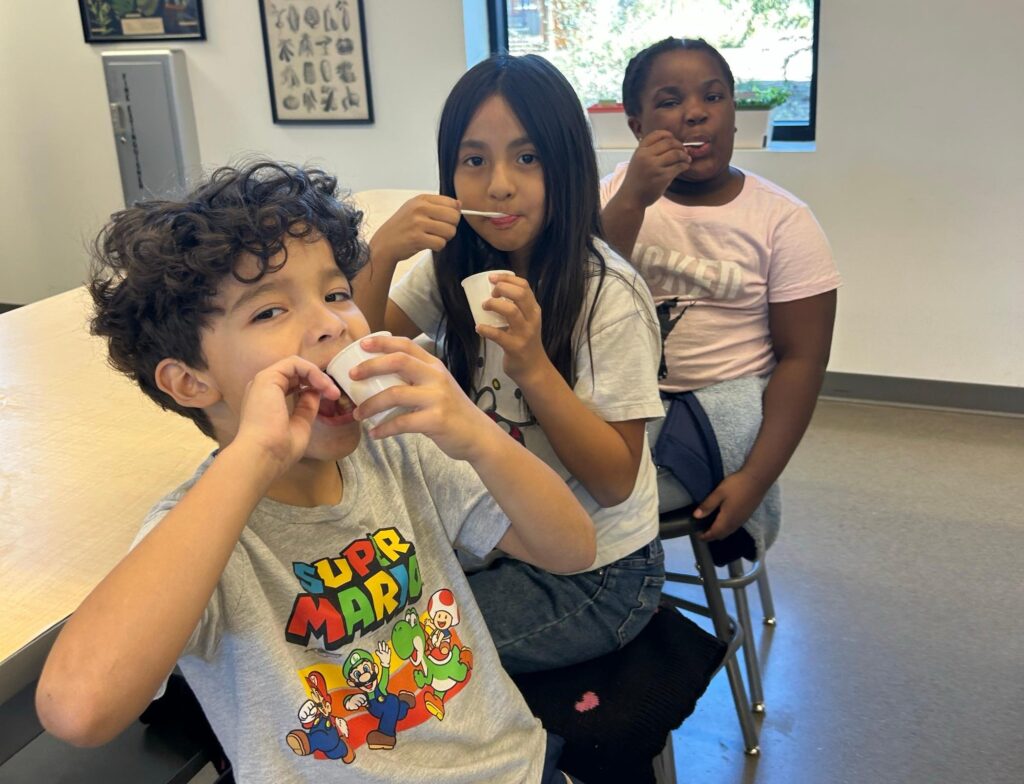
“Our school is in an urban area with about 265 students. Our student population is 80% Hispanic with 30% of our students being English language learners. Our student population is also 19% special education with two self-contained programs that uniquely service medically fragile and developmentally delayed students.”
How have you connected your adopted calf to your classroom?
“My students have loved feeling connected to our cow knowing she is from a local farm. They really look forward to the monthly updates, and she comes up in conversation or lessons organically all the time. An exciting moment was when we found out that our cow was going to be showing at our county fair. The students were so excited at the possibility of seeing her in person.”
Why do you think it’s important for students to learn where their food comes from?
“It’s important for students to learn about agriculture, because it’s a potential career path that is crucial. There are so many opportunities in ag, especially in Arizona. Through my class, I really want the kids to understand the time, effort, and resources that go into getting our food onto our plates. I have seen amazing growth in their open-mindedness and respect for animals and food through teaching about agriculture.”
—
The Adopt a Cow Program is now open for enrollment through January 31 for the 2026-27 school year! Click here to learn more and adopt a cow for your classroom today. Sign up by September 1 to receive a mailed welcome packet. The program, which impacted more than 2.1 million students last school year, is free thanks to support from Discover Dairy partners and donors.
Discover Dairy is an educational series managed by the Center for Dairy Excellence Foundation of Pennsylvania in partnership with American Dairy Association Northeast, American Dairy Association Indiana, Midwest Dairy, The Dairy Alliance, Dairy Farmers of Wisconsin, Dairy Management West, Dairy West, New England Dairy, American Dairy Association Mideast, Dairy Council of Florida, and Maine Dairy and Nutrition Council.
Meet Angela: Indiana Teacher Who’s Connecting Students to Farmers in Their Community
This story is part of a series of “meet & greets” with individuals who use our Adopt a Cow program to inspire you with the endless ways you can incorporate the program in the classroom and beyond!
Angela Grills has been teaching for 34 years, and if there’s one thing she is passionate about, it’s helping her first-grade students gain an appreciation for the community around them. With dairy farms just a few minutes down the road from their elementary school in Indiana, Discover Dairy’s free Adopt A Cow program has helped her share some of the real-world impacts that agriculture has on their area.
“We have a huge agricultural community and lots of farmers in our area. Even though our kids are driving by some of the farms, they don’t necessarily have much connection to them,” Angela shared. “This was actually our first year participating in Adopt A Cow. We have been partnering with Ag in the Classroom through Farm Bureau for the last several years as well as our Purdue Extension here in our local community. Adopt A Cow was such a nice fit. We were looking to continue with that agricultural topic and incorporate it into our curriculum.”
After “adopting” a calf for her classroom, they received photo and video updates throughout the year along with other classroom enrichment activities. Not only did Angela build on her monthly ag in the classroom lessons, but the program helped her team make STEM connections and work toward a STEM certification for their school.
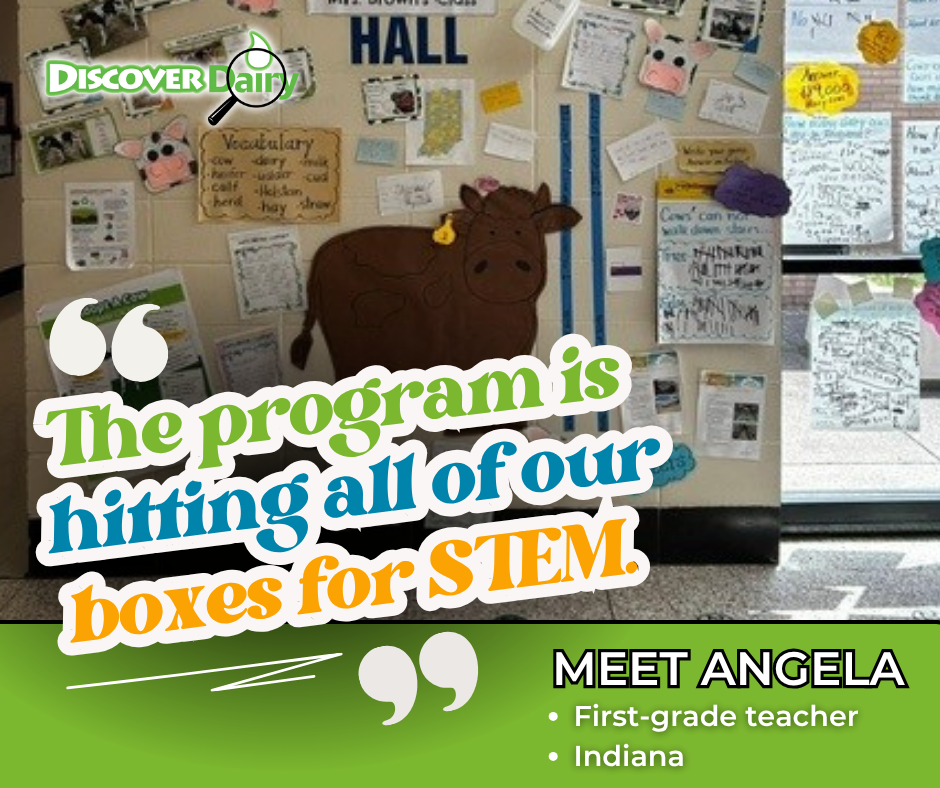
“We [incorporated the program] all the way across our curriculum. We’re trying to become STEM certified at our school. From reading and writing to science and math, anything we could make it fit into, we were trying to pull that out each month. The program is fantastic. It’s hitting all of our boxes for STEM,” she added.
Using several activities the program provided, such as a growth chart to compare the cow’s size to students’ heights, Angela found creative connections to make with her class.
- Math connections: “We had an entire wall devoted to the cow. When we got our updates with our cow’s weight and height, we would take turns taking our class out to the cow wall. We would mark the measurements on the wall so they could see how much taller their cow had gotten. We would also talk about the weight. We brought in gallon jugs to show how much milk they produced each time.”
- Reading and writing: “We would read books about different cows and dairy cows in in particular. We wrote facts about them. We used it for our writing, and we even wrote letters to our cow.”
- Ag in the classroom connections: “Our Ag in the Classroom coordinator was fantastic because when she would read books about corn, for example, we would connect it to what the cows eat. The Adopt A Cow program just blended in so nicely.”
While these curriculum connections are important, Angela says the program also sparked her students to appreciate where they live – and the farmers that support their community.
“Agriculture is a large part of our community. We have a lot of kids who are in poverty, so they don’t always get to travel and go places even though there are farms just a few minutes down the road,” Angela said. “I’ve been born and raised in this community. I’ve taught for 34 years, and I went to this elementary school when I was a little kid. I just want them to have a good understanding of what our community is all about because it is a large agricultural area.”
—
The Adopt a Cow Program is now open for enrollment through January 31 for the 2026-27 school year! Click here to learn more and adopt a cow for your classroom today. Sign up by September 1 to receive a mailed welcome packet. The program, which impacted more than 2.1 million students last school year, is free thanks to support from Discover Dairy partners and donors.
Discover Dairy is an educational series managed by the Center for Dairy Excellence Foundation of Pennsylvania in partnership with American Dairy Association Northeast, American Dairy Association Indiana, Midwest Dairy, The Dairy Alliance, Dairy Farmers of Wisconsin, Dairy Management West, Dairy West, New England Dairy, American Dairy Association Mideast, Dairy Council of Florida, and Maine Dairy and Nutrition Council.
Meet Callie: Washington Teacher Who’s Bringing the Farm to Her Suburban Classroom
This story is part of a series of “meet & greets” with individuals who use our Adopt a Cow program to inspire you with the endless ways you can incorporate the program in the classroom and beyond!
Callie Bissonnette grew up in an area that was rich in agriculture. With her deep respect and appreciation for farmers, she decided to participate in Discover Dairy’s free Adopt A Cow program. As a second-grade teacher in suburban Washington, she hoped the program would expose her students to farming and food production.
“The school I work in has a high poverty rate, and students have limited experiences outside of their neighborhoods. I decided to sign up for Adopt A Cow because I wanted my kids in the city to better understand where their food comes from,” Callie shared.
Over the past four years, Callie has ‘adopted’ a calf for her classroom and watched it grow all year long. Using resources and lessons that the program provides, she has found creative ways to weave the calf information into her lessons and curriculum, including science and language arts. Several parents have also become curious after hearing their child’s excitement about the adopted calf, giving her an easy outlet for connecting parents to her students’ learning experiences.
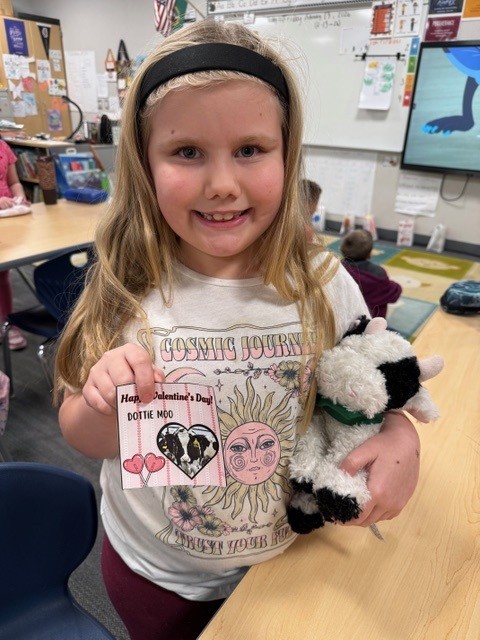
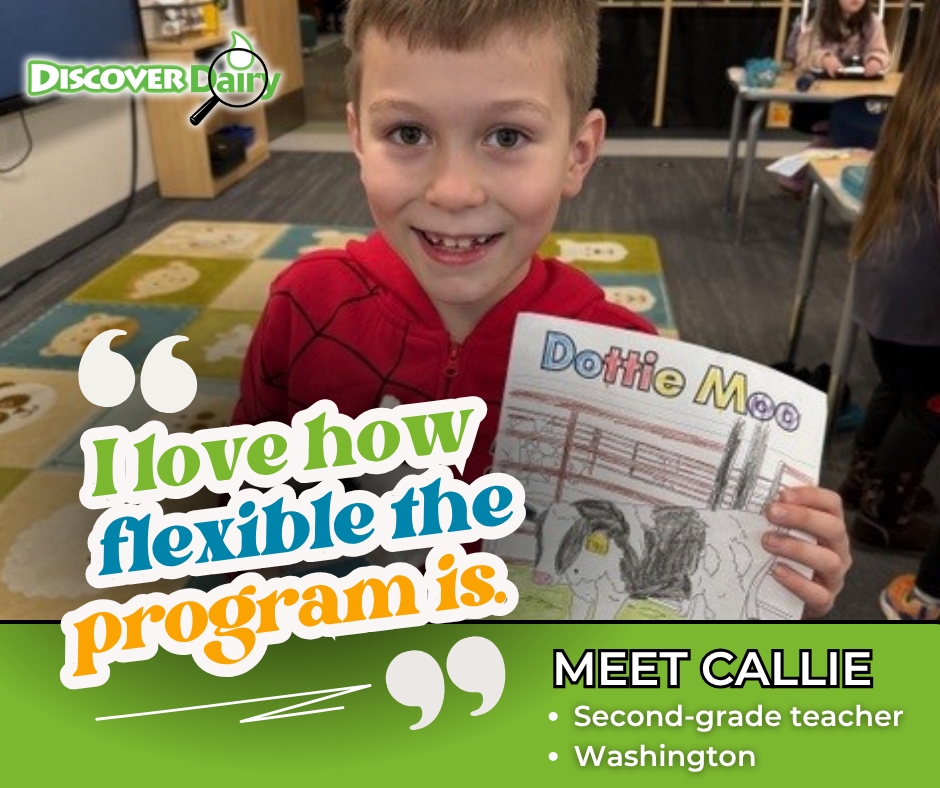
“I love how flexible the program is. You can make it fit your schedule and style. I use it as an enrichment and as part of my science [unit]. My kids love the calf updates and the virtual farm tour. I also had a few families download and use the Discover Dairy app,” Callie added.
In addition to her science unit, the Adopt A Cow program has helped her students gain skills with journaling and writing.
“I have a ‘cow caretaker’ each week. A student is assigned as the ‘cow caretaker’ and they get to have our stuffed cow at their desk. They are tasked with journaling things they do [with the stuffed cow] that week,” she explained. “At the end of the week, I check the journal and if they have made an entry, they get a cow pencil and a cow charm necklace.”
Ultimately, the Adopt A Cow program has exposed Callie’s students to broader concepts such as the role agriculture has in their community and possible career opportunities in the future.
“I want my students to understand the care that goes into ensuring they have fresh and healthy foods. I want them to see that hard work produces tangible benefits for their community. I also want them to be exposed to a variety of ideas of what they can do with their future,” she said.
—
The Adopt a Cow Program is now open for enrollment through January 31 for the 2026-27 school year! Click here to learn more and adopt a cow for your classroom today. Sign up by September 1 to receive a mailed welcome packet. The program, which impacted more than 2.1 million students last school year, is free thanks to support from Discover Dairy partners and donors.
Discover Dairy is an educational series managed by the Center for Dairy Excellence Foundation of Pennsylvania in partnership with American Dairy Association Northeast, American Dairy Association Indiana, Midwest Dairy, The Dairy Alliance, Dairy Farmers of Wisconsin, Dairy Management West, Dairy West, New England Dairy, American Dairy Association Mideast, Dairy Council of Florida, and Maine Dairy and Nutrition Council.
Grilled Cheese Dippers with Tomato Soup
April is National Grilled Cheese Month. Check out this fun recipe!
Dairy Fun Fact
Dairy farmers can reuse water for many purposes, including cleaning barns, irrigating crops, and cooling milk.
Share this fun fact with your students as they learn about the environment!
Mini Moo Virtual Dairy Tour: Soil Super Savers
Mini Moo Virtual Dairy Tour: Soil Super Savers: Corey the Cornstalk is digging deep to see how Farmer Austin from Peace N Plenty Farm in Union Bridge, MD protects the land! Join Corey to discover how farmer Austin’s best friend isn’t just the cows—it’s the soil. Learn about cool practices like no-till farming that keep the dirt in place and why planting cover crops acts like a superhero blanket for the fields, locking in nutrients and keeping the soil happy and healthy all year long! Age group? Elementary School.
Cows Are Upcyclers Video
Check out this cool video from on of our Adopt a Cow Host Farms, Coulee Flats Dairy in Washington, to learn more about how cows upcycle! Read more in an article about the farm as well. Age group? Middle School.